The New Arena: How Sports-Anchored Districts Are Reshaping Cities
October 2, 2025
Article originally published by Urban Land Institute >>
By Peter David Cavaluzzi, FAIA and Peter Broeder
In cities large and small around the world—from Columbus, Ohio, to Valencia, Spain—a major focus of modern urban revitalization has been the addition of new sports arenas, purposely built in concert with supportive, mixed-use developments that can become self-sustaining neighborhoods.
No longer content to build standalone stadiums with acres of parking that may be vacant or underutilized for long periods—and may have little or no direct benefit to the surrounding neighborhoods—city planners instead are leaning into a new model of large sports facility, one that puts a busy year-round complex at the center of a larger, thriving community. In the United States alone, the pipeline for these types of so-called sports districts over the next decade is projected to be tens of billions of dollars—and quickly gaining traction as an engine of major urban revitalization.
More important than the large size of these projects is their adaptability. In Europe, for example, where large acreage isn’t readily available to build at U.S. scale, new sports facilities can still capture similar benefits by integrating micro-parks, plazas, supporter squares, and other proven features into the complex. With more sophisticated, community-oriented approaches to venue design and programming, the economic activity typical of game days in nearby bars, restaurants, and retail shops can quickly be extended past these events to create active, year-round neighborhoods—and help redefine the very fabric of a city.
What’s driving this new approach and the influx of capital? And what can we expect from the next generation of sports-anchored districts?
Isolated “spaceships” vs. rebuilding cities
The radical evolution of stadium, ballpark, and arena architecture has occurred over a relatively brief period. The birth of modern-day sports facilities is largely attributed to the design of Arrowhead Stadium and Kauffman Stadium in Kansas City, Missouri, in the early 1970s. Both were among the earliest examples of single-purpose venues with modern amenities.
However, those stadiums are surrounded by a sea of parking, just off I-70, and are nearly 15 minutes from the heart of downtown. Like many other sports venues that came in later years, they lack thoughtful pedestrian scale or community connection. They function much like isolated spaceships—massive structures in the middle of a city, daunting in size and scale, with many missed opportunities to be valuable neighbors.
So what has changed?
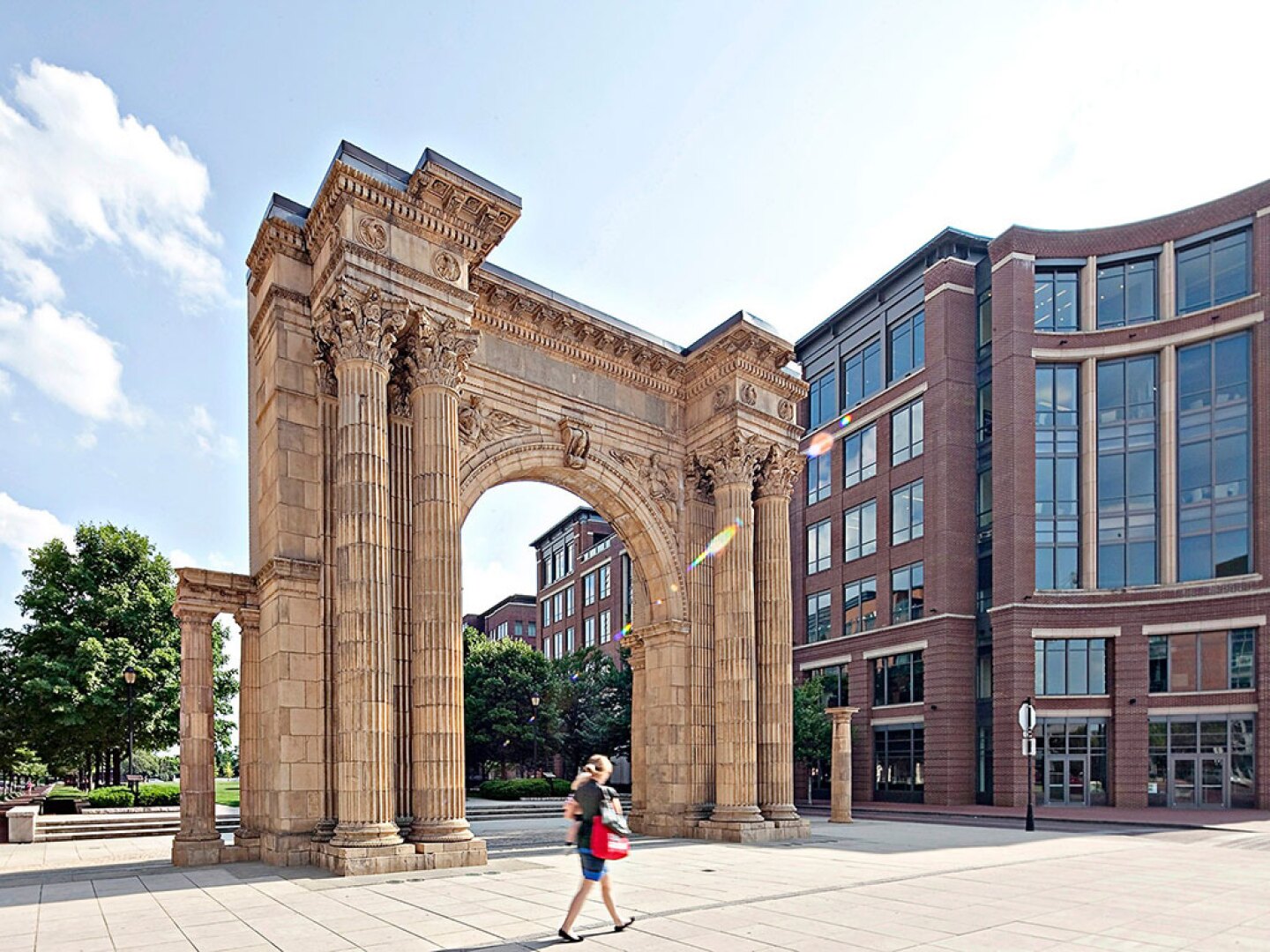
Twenty-five years ago, Nationwide Arena opened in Columbus, Ohio, and inspired a new era of community-centric venues and sports-oriented developments. It also gave many cities the case study they needed to pursue similar redevelopment. Led by Nationwide Realty Investors, MKSK, and HOK, the project was seen as a catalyst for strategic reinvestment in the city.
(HOK)
A standard-setting arena district
Isolated stadiums are quickly becoming a thing of the past. Today’s team owners, investors, and city planners—armed with benchmark data from past projects—are now looking to build sports complexes that will have transformational impact on a city, including 24/7 neighborhoods and mixed-use developments that can thrive economically regardless of game days.
Twenty-five years ago, Nationwide Arena opened in Columbus, Ohio, and inspired a new era of community-centric venues and sports-oriented developments. It also gave many cities the case study they needed to pursue similar redevelopment. Led by Nationwide Realty Investors, MKSK, and HOK, the project was seen as a catalyst for strategic reinvestment in the city, with more than 100 acres (40.5 ha) of arena-adjacent land converted into mixed-use and public spaces, including valuable infrastructure. Dubbed by The New York Times as “one of the Midwest’s most successful urban redevelopment projects,” the Nationwide Arena District challenged the car-centric status quo of modern stadium design by created a pedestrian-friendly tapestry of development that continues to expand.